
about the Breed
History of the Valais Blacknose Sheep
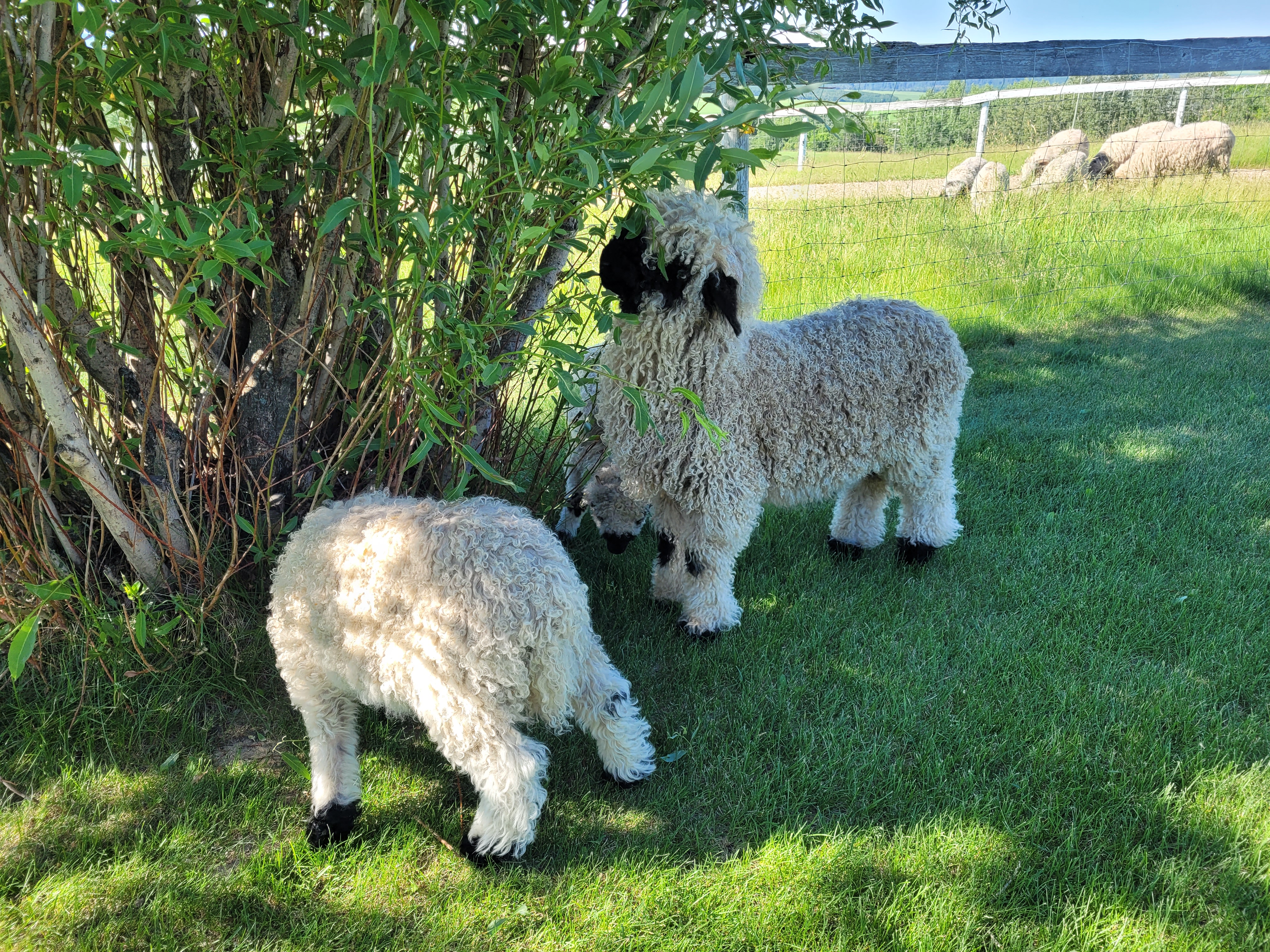
Valais Blacknose sheep originated in the Valais region of Switzerland. They are a dual-purpose breed, raised for meat and wool and are very hardy and well adapted to harsh conditions. Their white woolly coat and black highlights make them quite unmistakable. The rams have large helical horns and the ewes have spiral shaped horns that grow outwards horizontally.
The earliest mention of the breed dates back to about 1400 A.D. and they were first recognized as a separate breed in 1962.
They were almost exclusively raised in Switzerland until imported to the British Isles in 2013 and 2014 by several interested breeders. From there, the initial imported genetics in the form of semen and/or embryos made their way to North America via New Zealand. We began our program with imported semen in 2019 and embryos in 2020 and were among the first breeders in Canada to do so.
Frequently Asked Questions
Please explain "F" reference re: Valais Percentage
Breed Up Programs follow this generational code:
F1 = 50% Valais
F2 = 75% Valais
F3 = 87.5% Valais
F4 = 93.75% Valais
F5 = 96.875% Valais
Ewes are considered Purebred at F4, Rams at F5.
To calculate % of the offspring, take Valais % of the Ewe and add it to the Valais % of the Ram and divide that number by 2 - for example:
0% Ewe + 100% Ram = 100/2 = 50% (or F1)
50% Ewe + 100% Ram = 150/2 = 75% (or F2)
Can I use a Partbred Ram to advance %?
A partbred ram will impart some Valais characteristics to the offspring however the % increase is not officially recognized - a breed up program relies on use of Purebred semen or Ram
What is the difference between Purebred and Fullblood?
A Fullblood animal's roots can be traced back to the foundation stock - meaning Switzerland in the case of Valais Blacknose Sheep.
A Sheep that has been bred up through the percentage rankings to at least F4 in the case of a Ewe or F5 for a Ram is then itself considered a Purebred; however, no matter the Valais % in any given animal, a Purebred from a breed up program will never be considered a Fullblood
What about their wool?
They have an abundance of wool - we usually shear twice per year for the animal's comfort. The wool itself is considered to be on the coarse side of the scale and might not be the first choice for fine garments but it still makes good yarn and fiber suitable for numerous uses. In our part of the world (Western Canada) there is very little in the way of a profitable market for wool and to be honest, most farmers in this part of the world see it as a nuisance. We do our best to see that our wool is used and we offer it for free to anyone that wants to come and get it which works out well most of the time.
What is average body size for ewes and rams?
Average Valais Blacknose Ram is 75 to 83 cm in height and 80 to 130 kg weight. (29" to 33", 160 to 290 lb) Average Valais Blacknose Ewe is 72 to 78 cm in height and 70 to 90 kg weight. (27" to 31", 155 to 200 lb) This information is from Wikipedia - we have seen both Rams and Ewes who were larger than this - they are not a small sheep breed.
What is their temperament?
Perhaps one of their most endearing qualities is their calm, gentle, friendly demeanor - more like that of a dog than a typical sheep - and this applies to the Rams as well as the Ewes. We can walk up to any of our Purebreds and while one of us holds their horns, the other can trim their wool or give them an inoculation without any rodeo action at all - quite amazing and quite a health benefit to the owner as well. (Not so many visits to the physio clinic)
They also stand out as being intelligent and curious - in general they are a joy to be around.
What are their Breeding Characteristics?
They are not considered seasonal breeders meaning they can breed successfully at any time of the year - in our experience they are excellent mothers with good maternal instincts.
What about housing?
They are a very hardy breed of sheep; however, we believe it is important for them to have adequate shelter - it doesn't have to be much, just somewhere they can stay dry and get out of the sun - and if they might be lambing in inclement or cold weather, we have found that a "hot box" is useful - in our case this is a partly partitioned cubicle inside their shelter with a heat lamp.